

Alpe-Adria Cycle Path: stages, route and tips at a glance
The Alpe-Adria Cycle Path is one of the most famous long-distance cycle routes in Europe. Covering around 410 kilometers, it leads from the Mozart city of Salzburg across the Alps, through Carinthia and finally to the Adriatic Sea in Grado, Italy. Along the way, you cycle through alpine valleys, along rushing mountain rivers, past tranquil Carinthian lakes and finally to the coast of the Adriatic Sea.
What makes the Alpe-Adria Cycle Path special is its well thought-out route profile. Thanks to more than 20 tunnels, including the legendary Tauern Tunnel near Böckstein, the Alps can be crossed without steep pass roads. This makes it an unforgettable adventure even for amateur cyclists with a solid basic level of fitness.
Your accommodation on the Alpe-Adria Cycle Path
If you plan to cycle the Alpe-Adria Cycle Path in stages, you need accommodation that matches the rhythm of your cycle tour. The Boutique Hotel Goldenes Lamm in Villach is located directly on the route and is therefore an ideal stopover.
We offer secure storage facilities for bicycles and an early breakfast so that you are well fortified for your bike tour.
Alpe-Adria cycle path in Villach
Villach is one of the central stops on the Alpe-Adria Cycle Path. The town lies right at the intersection between the Alpine section in Carinthia and the more southerly part of the route towards Italy. Anyone arriving in Villach from the Möll and Drautal valleys will already have the most challenging altitude meters behind them.
In the old town, the alleyways, squares and the Drau invite you to stroll and relax. After a long day on the bike, Villach offers numerous restaurants and cafés, short distances and a relaxed atmosphere.
Stages of the Alpe-Adria Cycle Path
The Alpe-Adria Cycle Path is divided into eight classic stages. At a leisurely pace, the entire route can be covered in seven to eight days. As the cycle path runs along many railroad lines, individual stages can be shortened or bridged by train at any time.
| Stage | Start and finish point | Route | Duration | Difficulty |
| 1 | Salzburg – Bischofshofen | 54 km | approx. 4 h | medium |
| 2 | Bischofshofen – Bad Gastein | 52 km | approx. 4:45 h | heavy |
| 3 | Bad Gastein – Spittal an der Drau | 59 km | approx. 3:30 h | medium |
| 4 | Spittal an der Drau – Villach | 39 km | approx. 2:15 h | light |
| 5 | Villach – Tarvisio | 37 km | approx. 3:20 h | medium |
| 6 | Tarvisio – Venzone | 57 km | approx. 4 h | light |
| 7 | Venzone – Udine | 56 km | approx. 4 h | light |
| 8 | Udine – Grado | 57 km | approx. 4 h | light |
Map and route
The Alpe-Adria Cycle Path starts in the heart of Salzburg and initially follows the Salzach upstream through Salzburgerland. Via Bischofshofen and Bad Gastein, you enter the Gastein Valley, where the famous Tauern lock awaits at Böckstein. A short train ride through the Tauern tunnel takes you to Mallnitz on the Carinthian side of the Alps.
From there, the route descends steeply into the Mölltal valley and continues along the Drau river through Spittal to Villach. From Villach, the route changes to the Gailtal cycle path towards Arnoldstein and crosses the border into Italy shortly afterwards. The first Italian stop is Tarvisio, from where the route follows the old Pontebbana railroad line through the Kanaltal valley. Many cyclists consider this section to be the most beautiful of the entire tour.
The route continues via Venzone and Gemona to Udine, the largest city along the Italian route. The last stage leads through the fortified town of Palmanova and the Roman city of Aquileia, before a causeway leads to the Grado peninsula and directly to the Adriatic Sea.
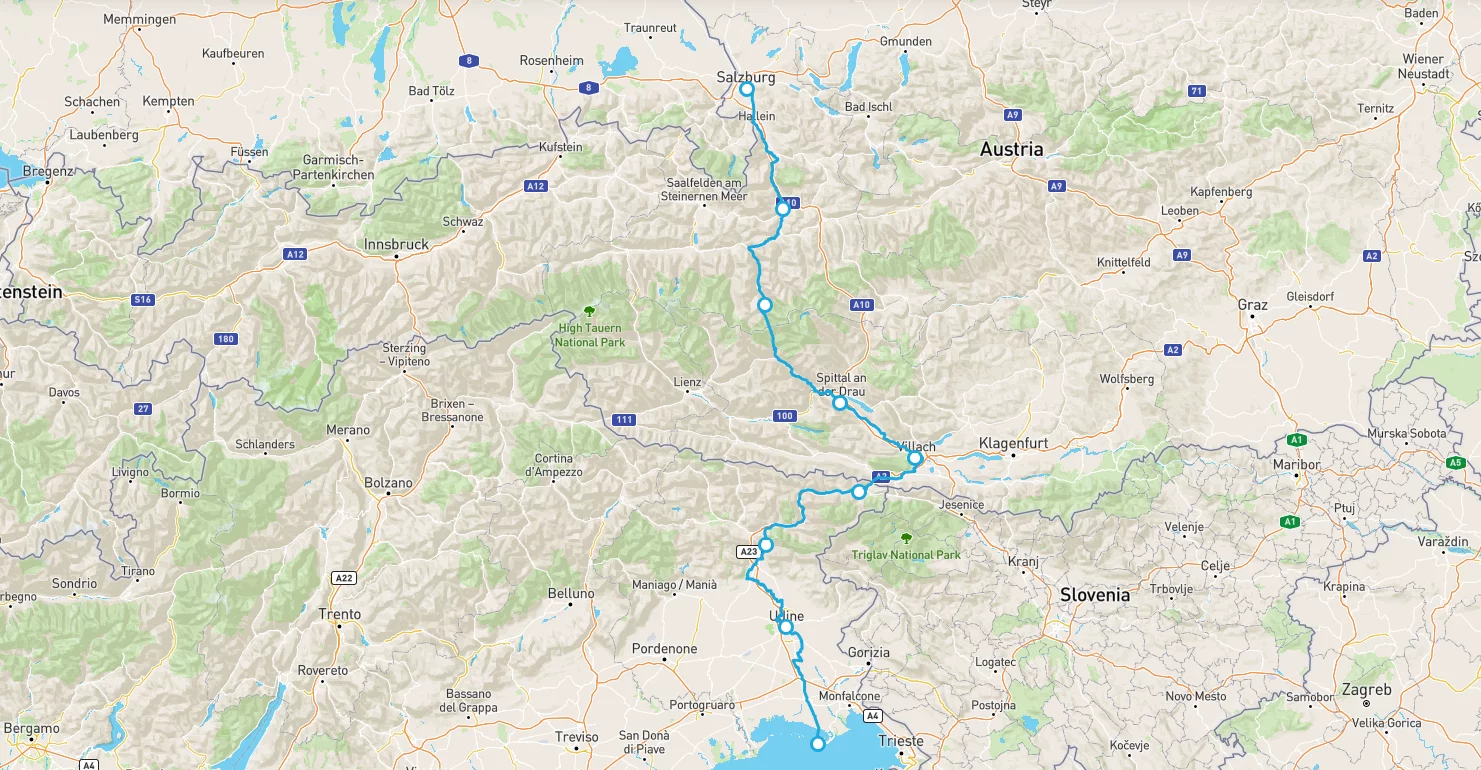
Alpe Adria Cycle Path Map © www.alpe-adria-radweg.com/map
Further maps, GPX data and a digital trip planner can be found on the official website of the Alpe-Adria Cycle Path.
Tips for your tour along the Alpe-Adria Cycle Path
With the right preparation, the Alpe-Adria Cycle Path will be an all-round successful experience. We have summarized the most important tips for your tour.
- Best time to visit: The ideal time to visit is from June to October. June, July and September are particularly recommended. It can get very hot in August, especially in Friuli in Italy.
- Stage planning: Plan seven to eight days for the entire route. Book accommodation early in the summer months, as the cycle route is very popular.
- Bike choice: Trekking, gravel or e-bikes are recommended. Road bikes and city bikes are not suitable for certain sections.
- Luggage transportation & return journey: Several shuttle providers transport your luggage from stage to stage. For the return journey, we recommend the train between Udine and Villach and back to Salzburg. All providers and travel times can be found at www.alpe-adria-radweg.com/service.
- Signage: The cycle path is signposted throughout with the official logo.
- Weather: The weather can change quickly in the alpine section. Functional clothing and a rain jacket belong in your luggage on the Alpe-Adria Cycle Path.
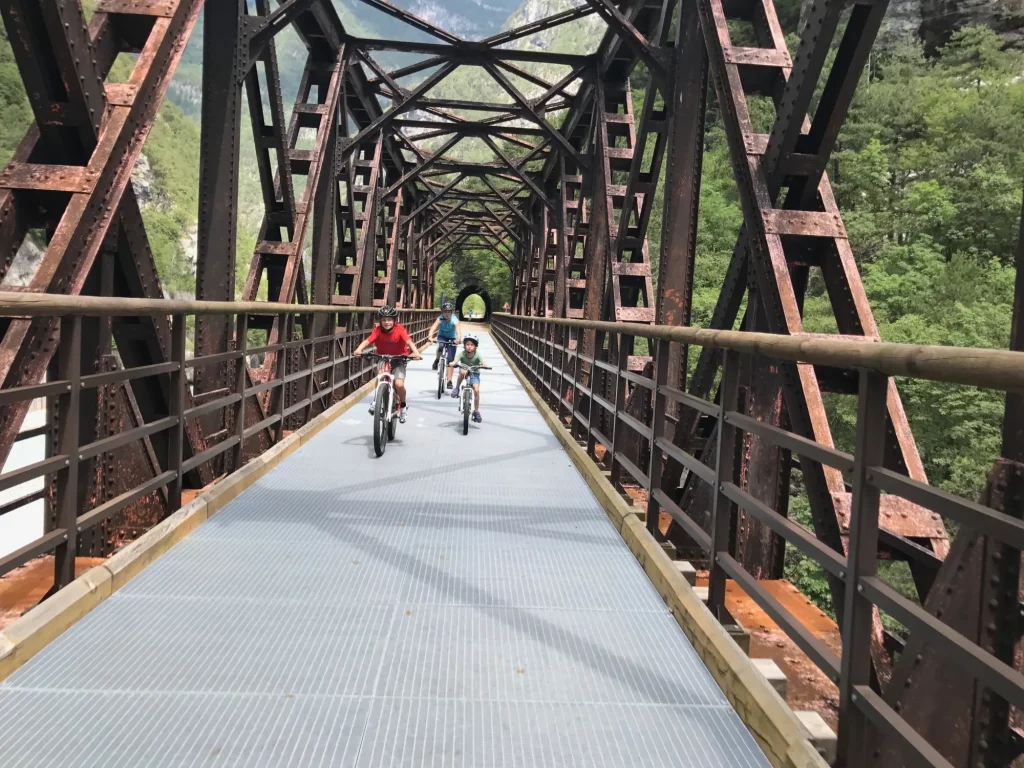
Alpe Adria Cycle Path | @ Kärnten Werbung | Wrolich Paco
FAQs about the Alpe-Adria Cycle Path
How long does it take to cycle the Alpe-Adria Cycle Path?
Most cyclists plan seven to eight days for the entire route. If you want to take it easier, you can also take ten to twelve days. Cyclists in good physical condition can complete the route in five to six days.
How many stages does the Alpe-Adria Cycle Path have?
The Alpe-Adria Cycle Path is divided into eight classic stages, each with a length of 37 to 59 kilometers. As the cycle path runs along many railroad lines, individual stages can be flexibly adapted or shortened.
How strenuous is the Alpe-Adria Cycle Path?
The level of difficulty is medium. With a solid basic level of fitness, the route is also suitable for amateur cyclists. The most challenging section is the ascent through the Gastein Valley with an elevation gain of over 1,000 meters. From Mallnitz onwards, the route becomes significantly flatter.
How many meters in altitude does the Alpe-Adria Cycle Path have?
On the entire route, you will climb around 2,400 meters in altitude.
Is the Alpe-Adria Cycle Path well signposted?
Yes, the cycle path is signposted throughout with the official logo.
When is the best time to cycle the Alpe-Adria Cycle Path?
The ideal time for the Alpe-Adria Cycle Path is from June to October. June, July and September are particularly recommended. It can get very hot in Friuli in August.
Which bike is suitable for the Alpe-Adria Cycle Path?
Trekking, gravel or e-bikes are recommended. Road bikes and city bikes are not suitable for some unpaved sections. An e-bike is a comfortable choice, especially for the Austrian section with its climbs.